
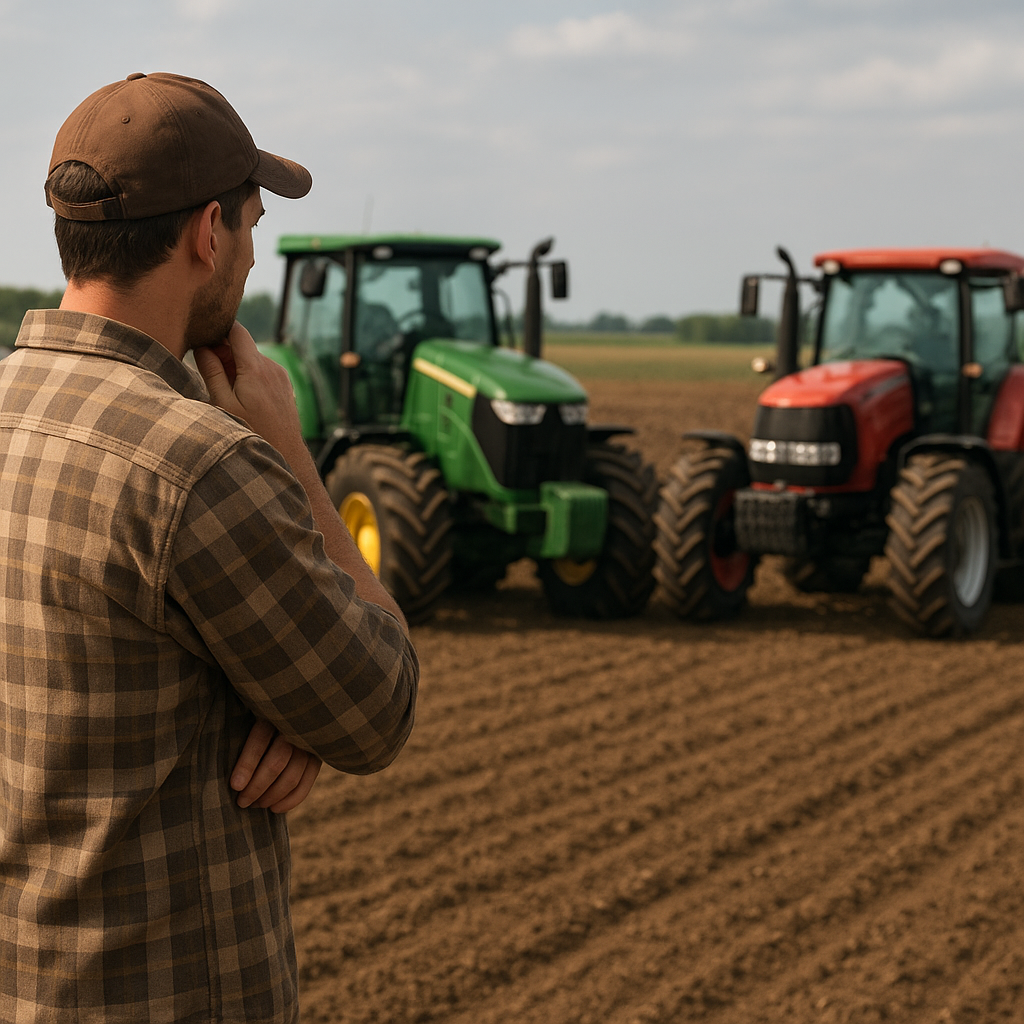
Choosing the right tractor is one of the most important investment decisions on any modern farm. The machine you select will influence your productivity, production costs and long‑term profitability for many years. A well‑matched tractor can reduce fuel consumption, save working hours and protect the soil, while a poorly chosen one may become an expensive burden that is difficult to maintain or adapt to changing tasks. On platforms such as tractor24.in you can compare many models, but before you start browsing offers, it is worth understanding what exactly you need. In this guide, you will learn how to define requirements for tractor power, transmission, hydraulics, comfort and technology, and how to adapt all of this to your type of farming, field size and budget.
Assessing your farm’s profile and needs
The first step to choosing the right tractor is to clearly define what work it will perform. A small family farm with mixed crops has very different needs than a large grain enterprise or a dairy farm focused on forage production.
Start by listing all main tasks across the year. Include soil preparation, sowing, spraying, fertilizing, harvesting support, transport and any work with front loaders or stationary implements. Then estimate how many hours per year the tractor will realistically work and in what conditions it will be used most often. More hours in heavy draft work, such as deep ploughing or subsoiling, require a more powerful and more durable machine. In contrast, a tractor that mainly handles transport or light yard duties can have less power but should offer agility and low fuel consumption.
Soil type is also important. Heavy clay soils demand more traction and higher engine power than light sandy soils, especially when using wide implements. If your land is hilly or includes long slopes, pay attention to braking performance, stability and the efficiency of the transmission. The combination of tasks, soil type, terrain and expected annual workload will form the foundation of your tractor specification.
Choosing the right horsepower range
Once you know your tasks, you can start matching the necessary power. Tractors are commonly categorized as compact (up to about 60 hp), medium (60–140 hp) and high‑power (above 140 hp). Every category has advantages and limitations, and there is no universal ideal solution for all farms.
Compact tractors are appreciated on small farms, in orchards, vineyards and livestock yards. They are easy to maneuver in tight spaces, consume little fuel and are usually cheaper to buy and maintain. However, they struggle with heavy draft implements and are less suitable for large‑acre cereal production. Medium‑power tractors, in the 90 to 130 hp range, are often referred to as “universal” because they combine sufficient field performance with reasonable size and running costs. For many mixed farms, this range gives the best balance between power and versatility.
High‑power tractors above 140 hp are recommended for large arable farms, contractors and operations that regularly use wide seeders, cultivators, ploughs and trailers with high load capacity. They offer great productivity, but their weight and size may be excessive on small plots and in narrow farmyards. When estimating needed power, check the requirements of your implements and add a reserve of at least 15–20 percent to maintain effective work at optimal engine speed rather than at permanent maximum load.
Transmission types and their impact on work
The transmission determines how effectively engine power is delivered to the wheels and how comfortable your work will be. Traditional manual gearboxes with synchronized gears remain popular due to their simplicity, durability and relatively low price. They are a good choice if you prefer straightforward mechanics and plan to keep the tractor for many years with limited repair costs. However, frequent gear changes during tasks such as front loader work or transport can be tiring.
Power‑shift transmissions allow changing several gears under load without using the clutch. This solution significantly improves comfort and keeps speed constant, which is useful when working on slopes or during operations that demand stable ground speed. For operators who spend many hours a day in the tractor, this comfort quickly translates into higher productivity and reduced fatigue.
Continuously variable transmissions, often called CVT or stepless, offer unlimited speed selection within a given range while maintaining optimal engine revolutions. They are ideal for precision fieldwork, such as planting or spraying, where constant travel speed is critical to achieving uniform results and saving material. Although CVT tractors are more expensive and their service can be more complex, they provide excellent fuel efficiency and ease of operation, especially for less experienced workers.
Hydraulics, PTO and compatibility with implements
When choosing a tractor, many farmers focus mainly on power, forgetting about the hydraulic system and power take‑off. Meanwhile, these elements decide whether the tractor can effectively operate modern implements. Check the maximum hydraulic flow available on the rear and front distributors, as well as the number of hydraulic outlets. Larger and more advanced machines, such as combination seeders, folding cultivators or loaders with extra functions, often require a high‑capacity hydraulic pump.
The lifting capacity of the rear three‑point hitch must exceed the demands of your heaviest implement with a safety reserve. Do not forget to include the weight of additional equipment like seed or fertilizer tanks. If you plan to use a front‑mounted tool, such as a mower or a front tank, make sure the tractor has a front linkage and front PTO as factory equipment or as an option.
The rear PTO speed, usually 540 or 1000 rpm, should match the requirements of your mowers, balers, spreaders or rotary tillers. Many modern tractors offer multiple PTO speed modes, allowing you to run lighter implements at lower engine revs and save fuel. Thoroughly check the dimensions and category of the three‑point hitch to ensure full compatibility with your existing implement fleet.
Traction, weight distribution and tires
Effective transfer of power to the ground depends not only on horsepower, but also on tractor weight, wheelbase, axle design and tires. A heavier tractor offers better traction in difficult conditions and with heavy draft implements, but it may cause more soil compaction and be less economical in light tasks. On small or sensitive fields, excessive weight can be a serious problem, especially in wet seasons.
Balanced weight distribution between the front and rear axles is crucial for stability and steering control. When using a heavy rear‑mounted implement or towing a large trailer, front ballast or a front loader can help keep the tractor safely planted. Adjustable wheel track width improves stability on slopes and reduces the risk of rollover when working across steep terrain.
Tire selection is another key element. Radial tires with large contact area reduce pressure on the soil, improve traction and reduce fuel consumption. For farms that often work on the road, hybrid or multi‑purpose tread patterns can provide a compromise between field performance and road comfort. Pay attention to tire size, possible use of dual wheels and the option to work at lower pressures, for example with central tire inflation systems, which significantly protect soil structure.
Cab comfort and ergonomics
Many farms operate tractors for hundreds or even thousands of hours per year. In such conditions, the quality of the cab and ergonomics of controls are not a luxury, but a factor directly affecting work safety and effectiveness. A comfortable seat with air suspension, adjustable steering column and well‑organized control layout reduce fatigue and the risk of operator errors.
Good visibility in all directions, including to the rear and high to the front for loader work, helps avoid collisions, protect crops and operate implements precisely. Modern cabs are equipped with efficient heating and air conditioning, improving working conditions in both summer heat and winter cold. Noise reduction measures lower stress and protect hearing over long periods.
Access to the cab and exit during frequent stops should be safe and convenient, with non‑slip steps and solid handrails. Consider also storage space for tools, documents and personal items. When the operator feels comfortable and has everything at hand, daily tasks are completed faster and with fewer mistakes.
Electronics, precision farming and connectivity
Technology is playing an increasingly important role in modern agriculture, and tractors are now platforms for precision farming systems. Decide whether you need solutions such as automatic steering, section control, variable‑rate application or telematics. Even if you are not planning immediate implementation, it may be wise to choose a tractor prepared for such equipment.
Many models offer an ISOBUS terminal that allows you to control compatible implements from a single screen in the cab. This eliminates the need for multiple separate controllers, simplifies operation and reduces cable clutter. Automatic steering systems improve work accuracy, reduce overlaps during sowing or spraying and allow effective work at night or in poor visibility.
Telematics solutions can monitor fuel consumption, location, work time and machine parameters in real time. For larger farms and contractors, this information helps optimize routes, schedule maintenance and analyze costs. When choosing a tractor, check whether software updates and access to data services are included or require additional subscriptions.
Fuel efficiency and operating costs
The purchase price of a tractor is only the beginning of total cost of ownership. Fuel, maintenance, repairs, tires and depreciation will affect your financial results for years. Therefore, it is worth paying attention to engine technology, emissions systems and the availability of qualified service.
Modern engines with common‑rail injection and turbocharging often provide excellent fuel efficiency, especially when combined with advanced transmissions. However, emissions regulations may require the use of aftertreatment systems like diesel particulate filters or selective catalytic reduction. These solutions reduce pollution, but increase technical complexity and may require additional operating fluids.
Regular maintenance, such as oil and filter changes, is essential for reliable work. Before buying, check service intervals, the cost of parts and the availability of authorized workshops nearby. Ask about typical failure points and the average lifespan of critical components. A tractor that is slightly more expensive to purchase but cheaper and more reliable to operate can bring greater savings over its entire working life.
New, used or leased tractor?
Financing method and the choice between new or used equipment has a significant impact on your budget and risk level. A new tractor offers full warranty, modern technology and lower probability of unexpected breakdowns, but its price is higher and it loses value quickly in the first years. For many farms, new equipment is justified when the machine will work intensively and is crucial for the continuity of production.
Used tractors can be an attractive option if your budget is limited or you need an additional machine for seasonal work. However, a detailed technical inspection is essential, including hydraulic system tests, transmission performance, engine compression and signs of excessive wear. A seemingly cheap tractor may require costly repairs soon after purchase, eliminating earlier savings.
Operational leasing or long‑term rental provide access to modern tractors without large initial capital outlay. Monthly payments can be easier to plan than unpredictable repair costs, and after the contract ends you can switch to a newer model. This solution is particularly interesting for farms that rely heavily on up‑to‑date technology and cannot allow long downtime during peak seasons.
Matching the tractor to your long‑term strategy
A tractor is an investment for many years, so it should be aligned not only with current, but also with future plans for your farm. Consider whether you intend to increase acreage, intensify production or change crop structure. If expansion is likely, it may be worth selecting a machine with a bit more power, better hydraulics or additional options that will provide flexibility.
On the other hand, excessive oversizing brings higher purchase cost, increased fuel use and sometimes difficulties in working small or irregular plots. Try to find a balance between current optimization and realistic future development. Analyze how the chosen tractor will cooperate with other machines on the farm, including combines, loaders, trailers and crop protection equipment.
Choosing the right tractor is a complex decision integrating technical, economic and organizational factors. By carefully assessing your needs, understanding key parameters and comparing different options, you can select a machine that will become a reliable cornerstone of your farm’s operations, supporting sustainable growth and stable profitability for years to come.
Leave a Reply